
Best Low-Temperature Hot Melt Adhesive for EPP Foam in Automotive Interiors
EPP foam is lightweight and useful in automotive interiors, but bonding it can be tricky. Too much heat may damage the foam, while too little heat can reduce adhesive wet-out and bond strength. A better approach is to build a controlled low-temperature bonding window around the real materials and process.
For heat-sensitive EPP foam in automotive interiors, a low-temperature hot melt adhesive should bond strongly without damaging the substrate. In one Vomelt internal test, HWP88 PP-based hot melt adhesive web bonded EPP foam to an automotive interior board at a processing temperature in the low-90°C range. During manual peel evaluation, the substrate failed before the adhesive interface separated. Pressure and dwell time still require application-specific testing.
That result is useful, but it is not a universal recipe. EPP grade, board material, adhesive weight, equipment, pressure, and dwell time can all change the final process window.
Our EPP Foam Bonding Test: What Actually Happened?
When we evaluate an EPP foam bonding project, we prefer to start with the real materials instead of choosing an adhesive only from a temperature chart.
In one of our internal automotive bonding tests, the construction included:
| Test Item | Internal Test |
|---|---|
| Substrate 1 | EPP foam |
| Adhesive | HWP88 PP-based hot melt adhesive web |
| Substrate 2 | Automotive interior board |
| Application | Automotive interior component |
| Main challenge | Heat-sensitive EPP substrate |
| Processing temperature | Low-90°C range |
| Bonding result | Substrate failure occurred before adhesive-interface separation |
| Pressure | Requires testing with actual materials |
| Pressing time | Requires testing with actual materials |
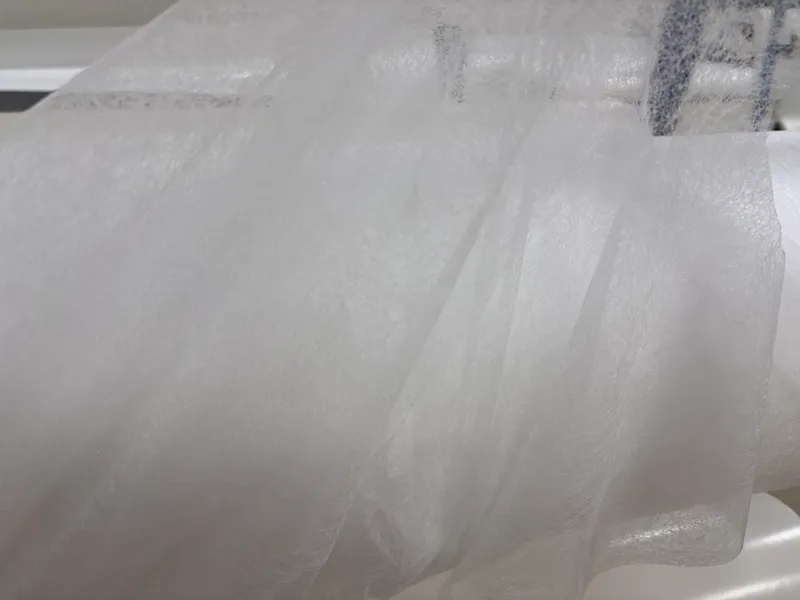
The main challenge was temperature.
The EPP component could not be exposed unnecessarily to a high processing temperature. We therefore needed an adhesive and process window that could produce strong bonding while reducing the risk of heat damage.
For this test, we used HWP88, a PP-based hot melt adhesive web, and adjusted the actual processing temperature to the low-90°C range.
The result was very strong.
During manual peel evaluation, the bonded construction could not simply be peeled apart at the adhesive interface.
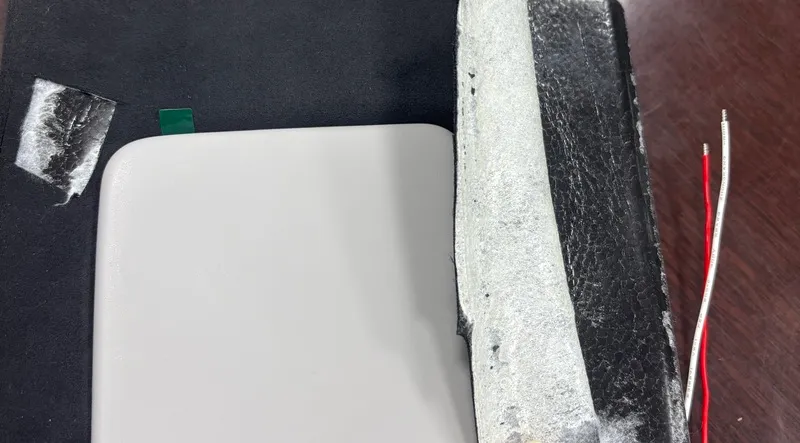
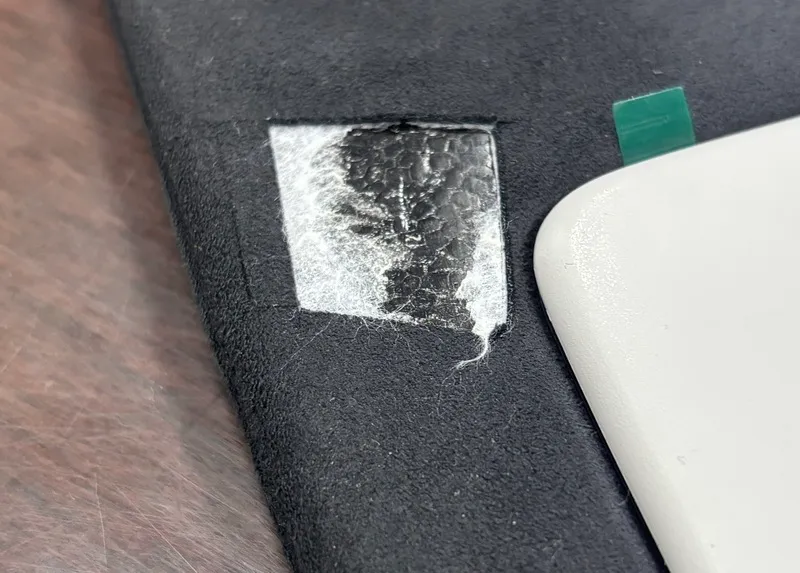
Instead, the substrate began to fail before the adhesive interface separated.
For us, that tells much more than simply saying the adhesive had “good adhesion.”
It indicates that, under the tested conditions, the adhesive interface was stronger than the portion of the substrate being stressed during the manual peel evaluation.
However, this does not mean every EPP application should copy the same temperature.
Can EPP Foam Be Bonded at Around 90°C?
Yes, it can be possible with the right adhesive, substrates, and process conditions.
In this internal test, HWP88 bonded EPP foam to an automotive interior board while the actual processing temperature was in the low-90°C range.
The bond was strong enough that substrate damage occurred before adhesive-interface separation during our manual peel evaluation.
But we do not recommend treating 90°C as a universal EPP bonding temperature.
A different project may use another EPP density, surface condition, board material, adhesive weight, machine, pressure, or production speed.
Any of these variables can change the final bonding window.
We therefore use the low-90°C test result as a real application reference, not as a fixed production recipe.
Why Is EPP Foam Difficult to Bond?
EPP is expanded polypropylene, so its surface behavior is closely related to polypropylene.
PP materials generally have relatively low surface energy, which can make them more difficult to bond than many polar substrates.
This is why simply choosing a conventional hot melt adhesive and increasing the temperature does not always solve the problem.
The foam structure creates another variable.
Two materials may both be called EPP but still differ in density, surface texture, molding conditions, thickness, and heat tolerance.
The second substrate also matters.
Bonding EPP to an automotive interior board is not necessarily the same as bonding EPP to fabric, film, metal, or another plastic.
That is why we prefer evaluating the entire material construction.
Why Does Processing Temperature Matter for EPP Foam Bonding?
With a hot melt adhesive, we need enough heat for the adhesive to activate and make effective contact with the substrates.
But higher temperature is not automatically better.
If the EPP component is heat-sensitive, too much heat can increase the risk of deformation or damage.
If the temperature is too low for the selected adhesive, however, the adhesive may not develop enough wet-out and bonding strength.
The real objective is:
Strong adhesion + substrate protection + stable production conditions.
That was the reason for moving toward a lower processing temperature in our HWP88 EPP test.
For other heat-sensitive bonding applications, you can also read our Temperature Resistance Guide.
Melting Range and Processing Temperature Are Not the Same
This distinction matters when customers compare different hot melt adhesives.
The melting range describes the thermal behavior of the adhesive itself.
The processing temperature is the actual temperature used during lamination or pressing.
These two values should not automatically be treated as the same number.
Heat still has to travel through the substrate and adhesive construction. Machine design, production speed, pressure, adhesive weight, and pressing time can all affect the real bonding condition.
You can also see our Hot Melt Adhesive Melting Range Guide.
For the HWP88/EPP test discussed here, the low-90°C value refers to the actual processing temperature used during the evaluation.
It is not being presented as a universal HWP88 or EPP specification.
What Type of Hot Melt Adhesive Works for EPP Foam?
For EPP foam bonding, we first want an adhesive system that can work with polypropylene-related substrates and within the heat limit of the component.
For this automotive test, we used:
HWP88 PP-based hot melt adhesive web
The adhesive chemistry is important, but chemistry alone is not enough to predict the result.
Customers researching hot melt adhesive chemistry may also encounter EVA, PUR, polyolefin, and other hot melt systems.
We do not recommend choosing a system based only on the polymer name.
The actual substrates and production conditions should determine which adhesive is tested.
For this EPP automotive construction, HWP88 provided the strong bonding result described above.
How Do We Test a Low-Temperature Hot Melt Adhesive for EPP?
When the substrate has limited heat tolerance, we prefer controlled testing instead of continuously increasing temperature until something sticks.
Our normal approach is:
- Confirm the actual EPP material.
- Confirm the second substrate.
- Understand the maximum temperature the part can tolerate.
- Select a suitable adhesive candidate.
- Run controlled bonding tests.
- Inspect both adhesion and substrate condition.
- Adjust temperature, pressure, and pressing time as needed.
- Confirm the final process window using conditions close to production.
This method helps us determine whether the problem comes from adhesive selection, processing conditions, or both.
How Much Pressure and Pressing Time Should Be Used?
We do not recommend publishing one fixed pressure or pressing-time value for this application.
Those parameters need to be tested with the customer’s actual materials and equipment.
Pressure changes the contact between the molten adhesive and the substrates.
Pressing time affects how much heat reaches the adhesive layer and how long the construction remains under pressure.
The correct conditions can change with EPP thickness and density, board construction, HWP88 web weight, equipment, heating method, and production speed.
So the low-90°C result is useful evidence that low-temperature EPP bonding is possible, but it should not be copied as a complete machine recipe.
Pressure and dwell time still need to be determined from the customer’s actual samples.
What Does Substrate Failure Tell Us?
This is one of the most important results from our test.
When we manually tried to separate the bonded construction, the adhesive interface did not simply peel apart.
Instead, the substrate started to fail first.
In practical terms, the adhesive interface was stronger than the portion of the substrate being stressed during that manual evaluation.
That is a positive bonding result.
However, substrate failure in one internal evaluation does not automatically prove every long-term automotive performance requirement.
Depending on the project, customers may still require testing such as heat aging, peel strength, environmental conditioning, dimensional stability, production repeatability, odor or emissions, and customer-specific automotive specifications.
Those requirements should be validated separately.
Is HWP88 Suitable for Every EPP Automotive Application?
No adhesive should be described that way without testing the actual materials.
HWP88 is a strong candidate when the project involves EPP or another PP-related substrate and a PP-based hot melt adhesive web is suitable for the construction.
Our existing test gives us a useful starting point:
EPP foam + HWP88 + automotive interior board + low-90°C processing → substrate failure during manual peel evaluation.
But your EPP material may not be identical to ours.
Your automotive board may also be different.
That is why we prefer receiving the customer’s actual substrates before recommending final production settings.
Hot Melt Adhesive for Automotive Interior Components
Automotive interior bonding can involve many different material combinations.
Headliners, foam parts, boards, carpets, fabrics, nonwovens, plastic components, and decorative materials can all require different adhesive behavior.
You can see more related applications on our Automotive Interiors page.
For an EPP project, we especially want to understand what the EPP is bonded to, the maximum acceptable processing temperature, the production equipment, available pressure, pressing time, and final bond requirements.
Once we know those conditions, adhesive selection becomes much more meaningful.
Need to Bond EPP Foam to an Automotive Interior Board?
If you are developing an EPP automotive component, send us your EPP foam and the second substrate.
It also helps if you provide your current processing temperature, maximum acceptable temperature, machine type, current adhesive, required bond strength, available pressure, pressing time, and final application requirements.
We can use those materials and process conditions to evaluate adhesive compatibility and establish a suitable starting window for temperature, pressure, and dwell time.
For applications similar to the case described above, HWP88 PP-based hot melt adhesive web may be one of the candidates we evaluate.
FAQ
Can hot melt adhesive bond EPP foam?
Yes, but adhesive selection and processing conditions matter. In one Vomelt internal test, HWP88 PP-based hot melt adhesive web successfully bonded EPP foam to an automotive interior board.
Can EPP foam be bonded at around 90°C?
It was possible in our tested material combination. The actual processing temperature was in the low-90°C range, and substrate failure occurred before adhesive-interface separation during manual peel evaluation. Other EPP applications still require individual testing.
What adhesive was used in the Vomelt EPP test?
We used HWP88, a PP-based hot melt adhesive web.
What pressure and pressing time should be used?
There is no universal setting. Pressure and dwell time should be optimized with the customer’s actual EPP, second substrate, adhesive weight, and production equipment.
Summary
EPP bonding balances adhesion, substrate protection, and process stability. For heat-sensitive automotive parts, a lower-temperature hot melt may help. Our HWP88 test reached substrate failure in the low-90°C range, while pressure and dwell time still require validation. Send us your materials and process conditions for sample testing.