
Coated and water-repellent leather can be difficult to laminate consistently. An adhesive that works well on untreated leather may show weak bonding, edge lifting, or delamination on a treated surface. In our experience, the right solution starts with understanding the leather surface, the second substrate, and the actual lamination conditions.
For coated or water-repellent leather, hot melt adhesive film should be selected based on the surface treatment, leather type, second substrate, flexibility, and processing temperature. Selected TPU grades are often useful starting options for flexible leather laminates, while PA, PES, or other adhesive systems may suit different substrate combinations. Because coatings can reduce adhesive wetting, the final grade and process should always be confirmed by testing the actual materials.
That means we should not choose an adhesive simply because a supplier says it is “for leather.” The finished surface can completely change the bonding behavior.
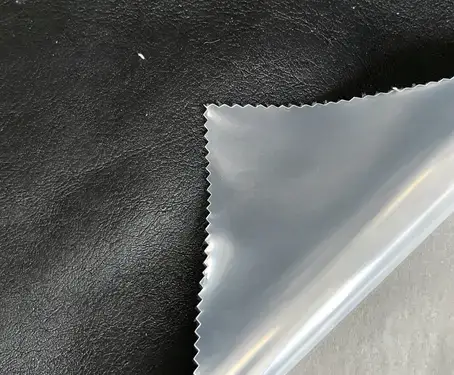
Why Is Coated Leather More Difficult to Bond?
Leather is not a single, standardized bonding surface.
Two materials that both look like leather can behave very differently during hot melt lamination. Genuine leather, PU synthetic leather, PVC leather, coated split leather, and water-repellent leather may all have different surface characteristics.
For adhesive selection, the surface we actually bond to matters more than the material name alone.
Surface Coatings Can Change Adhesion
Leather may contain surface finishes designed to improve appearance, abrasion resistance, color stability, water resistance, or hand feel.
Those finishes can also change how molten adhesive interacts with the surface.
During lamination, a hot melt adhesive needs sufficient contact with the substrate. If the adhesive does not wet the surface properly, the laminate may initially appear bonded but develop poor peel strength or edge lifting later.
This is why we do not recommend selecting an adhesive based only on the word “leather.”
We first ask:
- Is it genuine or synthetic leather?
- Is the bonding surface coated?
- Is there a water-repellent treatment?
- What material is on the opposite side?
- Does the finished laminate need to bend or stretch?
- How much heat can the complete structure tolerate?
These questions usually tell us much more than the leather name itself.
Water-Repellent Treatments Can Reduce Wetting
Water-repellent finishes are particularly important.
A surface designed to resist liquids may also make it more difficult for some molten adhesives to establish effective contact.
That does not mean water-repellent leather cannot be bonded with hot melt adhesive film.
It means actual-material testing becomes more important.
The adhesive chemistry, film thickness, temperature, pressure, and dwell time may all need to be adjusted.
Genuine and Synthetic Leather Behave Differently
Genuine leather has a natural structure and can vary between batches.
Synthetic leather may contain PU, PVC, textile backing, foam layers, or other constructions. The surface coating and backing can therefore be just as important as the visible face.
For this reason, we prefer to evaluate the complete material construction, not only whether a sample is called “leather.”
For a broader material-level overview, see our hot melt adhesive selection guide for leather.
What Hot Melt Adhesive Film Is Suitable for Coated Leather?
There is no single adhesive chemistry that is automatically best for every coated leather laminate.
TPU is an important starting option, but PA, PES, PO/EAA, TPE, or other systems can also be relevant depending on the application.
The goal is to match both chemical compatibility and mechanical behavior.
When Should You Evaluate TPU?
Selected TPU hot melt adhesive films are often worth evaluating when the finished leather laminate needs flexibility.
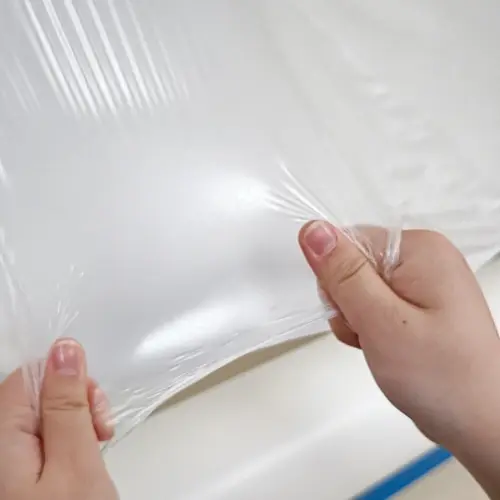
This can include applications involving:
- flexible leather components;
- shoe uppers;
- leather-to-textile lamination;
- leather-to-foam structures;
- synthetic leather;
- products exposed to repeated bending.
However, not every TPU grade behaves the same way.
TPU adhesive films can differ in melting behavior, elasticity, thickness, backing, and compatibility with specific surfaces.
For example, VOMELT has low-temperature TPU grades intended for heat-sensitive materials as well as more elastic grades for applications requiring greater flexibility.
The appropriate grade still depends on the actual leather and second substrate.
When May PA or PES Be Considered?
PA hot melt adhesive film and PES hot melt adhesive film may also be evaluated for selected leather laminates.
They should not be treated as automatic replacements for TPU.
Instead, we consider factors such as:
- the second substrate;
- required stiffness or flexibility;
- processing temperature;
- end-use environment;
- durability requirements;
- surface treatment.
The important point is that polymer name alone does not determine the result.
Why the Second Substrate Matters
When a customer asks us, “Which adhesive works on leather?” one of our first questions is:
What are you bonding the leather to?
Leather-to-fabric and leather-to-PVC are not the same bonding problem.
The adhesive has to interact with both sides of the laminate.
How Does the Second Substrate Affect Leather Bonding?
The second substrate can completely change the adhesive selection.
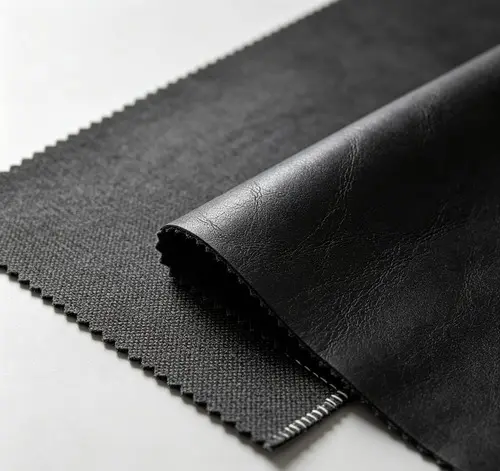
Leather to Fabric
Leather-to-fabric lamination is common in footwear, bags, accessories, automotive interiors, and other composite products.
Here we consider both the leather surface and textile construction.
A flexible TPU grade may be a useful starting point when softness and repeated bending are important. Other adhesive chemistries may be suitable depending on the textile fiber and end-use requirements.
The fabric itself can also affect adhesive penetration. A lightweight textile and a thick woven fabric may require different adhesive thicknesses and processing conditions.
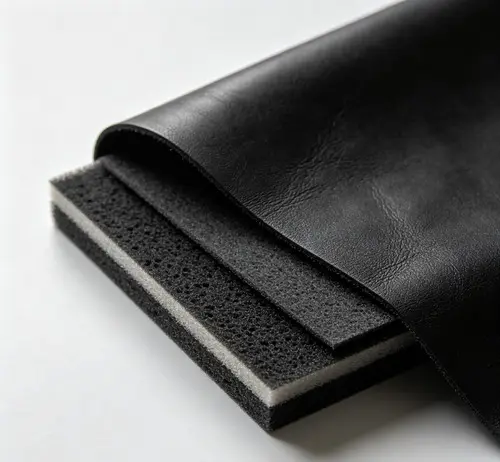
Leather to Foam
Foam introduces another variable: heat sensitivity.
Some foams can deform, compress, shrink, or change surface characteristics under excessive heat.
For these structures, we usually evaluate:
- leather surface compatibility;
- foam type and density;
- required bond strength;
- minimum practical processing temperature;
- flexibility after lamination.
A lower-temperature adhesive system may be useful when the foam or leather construction is heat-sensitive, but the complete laminate must still be tested.
Leather to TPU or PVC
Synthetic leather products often involve TPU, PVC, or other polymer layers.
In these cases, we need to identify the actual bonding surface rather than assume compatibility from the visible material.
Selected TPU adhesives may be evaluated for some combinations, while other chemistries may perform better on different polymer surfaces.
Plasticizers, coatings, and surface treatments can also influence the result.
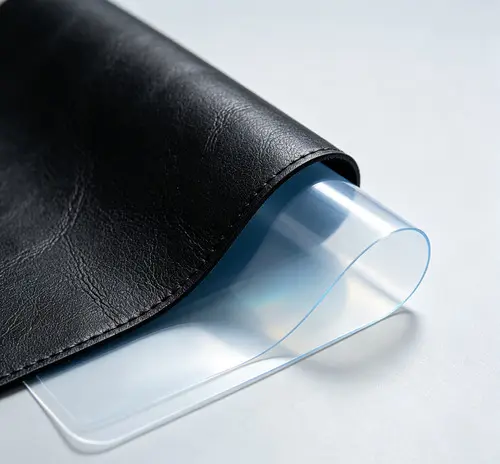
Leather to Rubber or Other Materials
Leather-to-rubber and leather-to-other-polymer bonding can be more demanding because the two surfaces may have very different chemical and mechanical characteristics.
This is a good example of why we avoid universal statements such as:
“TPU is always the best adhesive for leather.”
It may be a strong candidate for one structure and the wrong starting point for another.
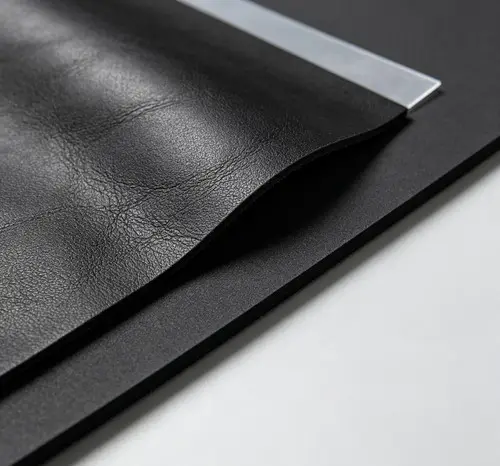
What Temperature Should Be Used for Leather Lamination?
There is no universal lamination temperature for leather.
The correct processing window depends on:
- adhesive grade;
- melting behavior;
- film thickness;
- genuine or synthetic leather;
- surface coating;
- second substrate;
- machine configuration;
- pressure;
- dwell time.
This is especially important with coated leather.
Increasing temperature can lower adhesive viscosity and improve wetting in some systems, but excessive heat can also damage the leather finish, deform synthetic layers, affect foam, or change the appearance of the laminate.
The machine set temperature also does not necessarily equal the actual temperature at the bonding interface.
We therefore treat the adhesive supplier’s processing range as a starting window, not a universal production recipe.
Final temperature, pressure, and dwell time should be established with the actual laminate.
Why Does Hot Melt Adhesive Film Fail on Coated Leather?
When a leather laminate fails, changing the adhesive grade immediately is not always the best first step.
We first try to identify the failure mechanism.
Poor Adhesive Wetting
If molten adhesive does not establish sufficient contact with the leather surface, bonding can remain weak.
Possible causes include:
- low interface temperature;
- short dwell time;
- unsuitable adhesive chemistry;
- difficult surface finish;
- insufficient adhesive coverage.
The failure surface can often provide useful clues.
Incompatible Surface Treatment
A coating or water-repellent treatment can change the bonding surface substantially.
Two visually similar leather samples may therefore produce different results with exactly the same adhesive and machine settings.
If one production batch bonds successfully and another does not, checking the surface treatment is often worthwhile.
Insufficient Heat or Dwell Time
The adhesive needs enough heat to activate and flow appropriately.
If heat transfer through the laminate is insufficient, the adhesive may not reach the condition required for effective bonding.
Simply increasing the machine temperature is not always the answer. Pressure, dwell time, film thickness, and layer construction should also be evaluated.
Excessive Heat
More heat does not automatically mean stronger bonding.
Excessive temperature can cause:
- surface damage;
- gloss or appearance changes;
- foam deformation;
- polymer-layer distortion;
- adhesive over-flow.
The goal is a stable process window, not the highest possible temperature.
Incorrect Film Thickness
Film thickness affects both adhesive quantity and finished laminate feel.
A film that is too thin may provide insufficient coverage for some uneven structures.
A film that is unnecessarily thick can increase stiffness, adhesive squeeze-out, cost, or visual impact.
We therefore choose thickness together with the adhesive grade rather than treating it as a separate specification.
Flexibility Mismatch
Leather products often bend repeatedly during use.
A bond can look acceptable immediately after lamination but fail later if the adhesive layer and substrates respond differently to repeated movement.
For flexible leather structures, initial peel testing alone may therefore be insufficient.
Repeated bending or flex testing can provide additional information about long-term interface behavior.
How Should Coated Leather Be Tested Before Production?
We prefer a step-by-step validation process.
1. Identify both substrates
Record the leather type, coating, backing, second substrate, thickness, and known surface treatments.
2. Select candidate adhesive grades
Choose candidates based on compatibility, flexibility, processing temperature, and end-use requirements.
3. Run small lamination trials
Evaluate practical combinations of temperature, pressure, and dwell time rather than changing multiple variables without a plan.
4. Evaluate the bonded interface
Peel or tensile testing can help compare candidate systems.
VOMELT has dedicated equipment for peel and tensile evaluation, but the test method should reflect the actual product requirement.
5. Test end-use durability
Depending on the application, this may include washing, humidity exposure, heat, repeated bending, or other application-specific conditions.
For flexible leather products, repeated-flex evaluation can be particularly useful.
6. Validate on production equipment
A laboratory result is only the starting point.
Before mass production, the selected material should be validated on the customer’s actual lamination process.
Can Surface Preparation Improve Leather Bonding?
Sometimes.
If the leather surface is difficult to bond, surface preparation may improve consistency. However, the correct method depends on the leather construction and finish.
Possible approaches can include cleaning, coating adjustment, primer systems, or other application-specific treatment.
We do not recommend applying a generic surface-treatment process without first checking whether it could damage the leather finish or affect the final product.
The first question should be:
Can we obtain reliable bonding with the correct adhesive grade and processing conditions on the existing surface?
If not, then surface preparation can be evaluated as another process variable.
What Information Should You Send to an Adhesive Supplier?
The fastest way for us to evaluate a leather bonding project is to receive information about the complete laminate.
We normally ask for:
- leather type;
- genuine or synthetic leather;
- coating or water-repellent treatment;
- second substrate;
- material thickness;
- required flexibility;
- current lamination equipment;
- available processing temperature;
- end-use application;
- durability requirements;
- existing bonding problem.
Whenever possible, actual material samples are even more useful.
A short description such as “I need glue for leather” leaves too many unknowns.
A description such as:
“PU-coated synthetic leather bonded to foam for a flexible shoe upper, with limited processing temperature”
gives us a much better starting point.
For footwear-specific applications, see our hot melt adhesive film solutions for footwear and leather.
How Can VOMELT Help with Coated Leather Lamination?
At VOMELT, we prefer to treat adhesive selection as a material-matching problem rather than simply recommend one polymer family.
For coated leather projects, we can evaluate factors such as:
- leather surface construction;
- second substrate;
- flexibility;
- processing temperature;
- adhesive chemistry;
- film thickness;
- roll or sheet format;
- application-specific testing requirements.
Depending on the selected grade, customization options may include thickness, width, roll length, slitting, or sheet cutting.
For projects where the correct adhesive is uncertain, sending both substrates for preliminary lamination testing can reduce unnecessary production trials.
Frequently Asked Questions About Hot Melt Adhesive Film for Coated Leather
There is no universal best grade. Selected TPU films are often useful starting options for flexible leather laminates, while PA, PES, or other systems may suit different substrate combinations. Surface coating, second substrate, processing temperature, and end-use requirements should all be evaluated.
Yes. Selected TPU hot melt adhesive films can be evaluated for genuine and synthetic leather, particularly in flexible laminates. However, coatings, water-repellent treatments, plasticizers, and the second substrate can affect adhesion, so actual-material testing is recommended.
It can, but water-repellent surface treatments may reduce adhesive wetting. Adhesive chemistry and processing conditions should therefore be evaluated on the actual treated leather rather than assumed from untreated leather results.
TPU, PA, PES, and other hot melt adhesive systems may be considered depending on the leather surface, textile fiber, flexibility, temperature limits, and durability requirements. Flexible TPU grades are often useful candidates when the finished laminate requires repeated bending.
The choice depends on both the leather and foam. Foam density, surface chemistry, heat sensitivity, and required flexibility should be considered. Lower-temperature compatible adhesive grades may be useful for heat-sensitive foam structures.
There is no universal temperature. The correct temperature depends on the adhesive grade, leather surface, second substrate, film thickness, pressure, dwell time, and equipment. Supplier processing ranges should be treated as starting conditions and verified through lamination trials.
Common causes include poor adhesive wetting, incompatible surface treatments, insufficient heat transfer, unsuitable adhesive chemistry, incorrect film thickness, or mechanical mismatch during bending. Examining the failure interface and testing alternative conditions can help identify the cause.
Hot melt adhesive can provide durable bonding when the adhesive, substrates, and process are properly matched. Durability should be evaluated against the actual end-use conditions rather than assumed from initial bond strength alone.
Final Takeaway
Choosing hot melt adhesive film for coated or water-repellent leather requires more than identifying the leather type. We recommend evaluating the surface treatment, second substrate, flexibility, processing limits, and durability requirements together, then confirming the final adhesive grade through actual-material testing.