
How to Choose Hot Melt Adhesive Film & Web for PVC Bonding
Bonding PVC can be more complicated than it first appears. The same adhesive may perform differently when PVC is bonded to fabric, foam, leather, or another material. If we choose only by the word “PVC,” we may overlook the second substrate, surface condition, flexibility, and lamination process.
Hot melt adhesive film or web can be used for PVC bonding, but the right choice depends on the PVC surface, second substrate, flexibility requirements, and lamination process. TPU film can be considered for flexible PVC-to-textile bonding, while adhesive web may suit structures involving porous materials such as foam. Always test the actual PVC and mating substrate before production because PVC formulations and surface conditions vary.
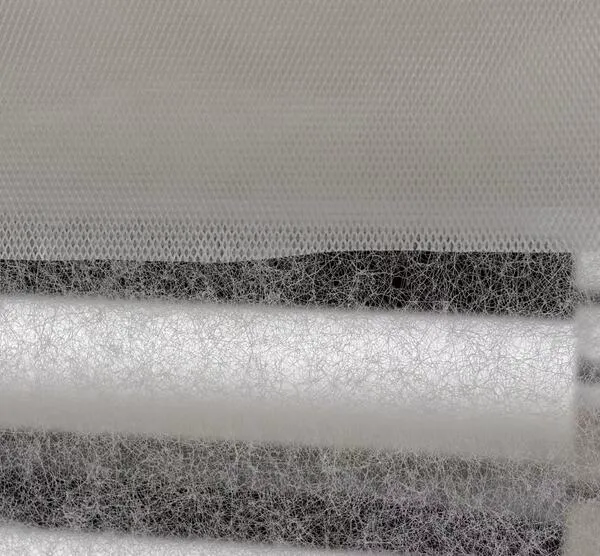
In our work, we have seen this clearly: two PVC bonding projects required very different adhesive solutions.
What Hot Melt Adhesive Works for PVC?
There is no single hot melt adhesive that we recommend for every PVC bonding application.
When a customer asks us, “Which adhesive should I use for PVC?”, one of the first questions we ask is:
What are you bonding the PVC to?
For example, the bonding structure might be:
- PVC patch to Oxford fabric
- PVC to polyester or another textile
- PVC to sponge or foam
- PVC to leather or coated material
- PVC to another plastic or film
These combinations can have very different requirements.
A flexible textile structure may need an adhesive that moves with the material. A porous foam structure may require a different adhesive form and coverage. Heat sensitivity, surface treatment, coatings, and the final application can also influence the selection.
This is why we prefer to evaluate the complete material combination rather than selecting an adhesive from the PVC name alone.
Should You Use Hot Melt Adhesive Film or Web for PVC?
Both hot melt adhesive film and hot melt adhesive web can be considered for PVC bonding, but they have different structures.
| Selection Factor | Hot Melt Adhesive Film | Hot Melt Adhesive Web |
|---|---|---|
| Adhesive structure | Continuous layer | Open, discontinuous structure |
| Adhesive coverage | Continuous coverage | Lower, open coverage |
| Flexible textile structures | Depends on adhesive grade and substrates | Depends on adhesive grade and construction |
| Porous substrates such as foam | Requires actual bonding evaluation | Can be worth evaluating |
| Selection basis | PVC, second substrate and process | PVC, second substrate and process |
A film provides a continuous adhesive layer between the materials.
A web has an open structure. Depending on the materials and construction, this can be useful when we want a different adhesive distribution or are working with porous substrates.
However, form alone does not determine bonding performance.
We still need to consider the adhesive polymer, PVC surface, second substrate, adhesive amount, and lamination conditions.
Can Hot Melt Adhesive Film Bond PVC to Fabric?
Yes, hot melt adhesive film can be used for some PVC-to-fabric bonding applications.
We have a real example involving a PVC patch and Oxford fabric.
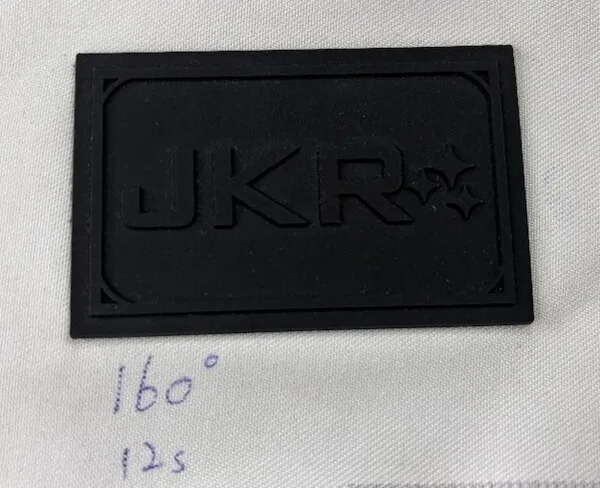
Real Application: PVC Patch Bonding to Oxford Fabric
In this application, the material combination was:
- First substrate: PVC patch
- Second substrate: Oxford fabric
- Adhesive: TPU hot melt adhesive film
- VOMELT model: XJU120
- Application: Logo bonding for caps and hats
We used XJU120 TPU hot melt adhesive film as the bonding layer between the PVC patch and Oxford fabric.
This type of application needs more than simply sticking two surfaces together. The bonding structure also needs to work with flexible textile materials and the actual heat-lamination process.
You can see the detailed application in our PVC patch and Oxford fabric bonding case.
This case does not mean XJU120 is automatically suitable for every PVC product. It shows that this TPU film has been used by us for this particular PVC patch and Oxford fabric combination.
When the PVC formulation, fabric, coating, or application changes, we recommend testing again.
Can Hot Melt Adhesive Web Bond PVC to Foam or Sponge?
PVC-to-foam bonding is another example of why the second substrate matters.
We recently evaluated a PVC and sponge combination using a PP hot melt adhesive web.
Real Bonding Test: PVC + Sponge
The test combination was:
- First substrate: PVC
- Second substrate: Sponge/foam
- Adhesive: PP hot melt adhesive web
- VOMELT model: W88
- Web weight: 80 g/m²
After bonding, we manually separated the materials to observe the bond.
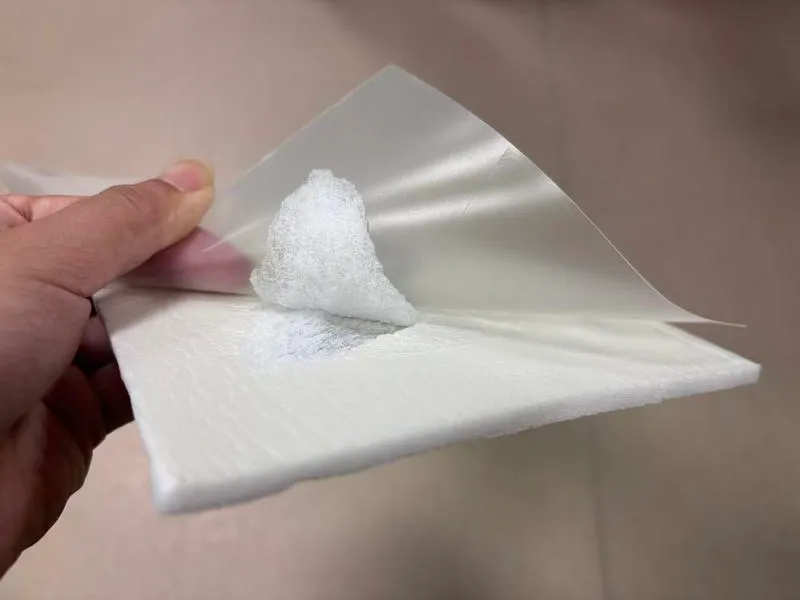
During separation, the sponge substrate tore rather than the bonded interface simply peeling apart.
This is a useful practical observation because it shows that the bond was strong enough in this particular material combination for failure to occur within the sponge during our manual separation check.
However, we do not treat this observation as a standardized peel-strength value.
We have not provided a measured N/cm peel result for this test, so we would not claim a specific bonding strength or guarantee the same result with every PVC or foam.
The final product application for this particular sample has also not been confirmed, so we do not assume an end use.
Why Does the Second Substrate Matter When Bonding PVC?
Our two real examples illustrate the selection problem well.
| PVC Bonding Combination | Adhesive Used | VOMELT Model | Practical Result |
|---|---|---|---|
| PVC patch + Oxford fabric | TPU hot melt adhesive film | XJU120 | Used for cap/hat logo bonding |
| PVC + sponge/foam | PP hot melt adhesive web | W88, 80 g/m² | Sponge tore during manual separation |
The first application used TPU film.
The second used PP web.
That leads to one of the most important rules we use when discussing PVC bonding:
The word “PVC” alone is not enough to select a hot melt adhesive.
The second substrate can change the bonding requirements significantly.
For example, bonding a flexible PVC patch to textile is not the same problem as bonding PVC to a porous sponge. Even if the PVC looks similar, the overall composite structure behaves differently.
That is why we normally want to know both materials before recommending a film, web, or adhesive polymer.
What Can Affect Adhesion to PVC?
Several factors can affect the result of PVC hot melt bonding.
PVC Formulation and Surface Condition
Not every PVC material has the same formulation or surface characteristics.
Plasticizers, coatings, surface treatments, contamination, and other formulation differences may influence how an adhesive interacts with the surface.
For this reason, a successful result with one PVC sample should not automatically be treated as proof for every PVC grade.
The Second Substrate
The other material may be just as important as the PVC.
Textile, Oxford fabric, foam, leather, and plastic surfaces have different structures and bonding behavior.
We therefore evaluate the material pair, not PVC in isolation.
Required Flexibility
If the finished structure bends, folds, stretches, or remains soft during use, the adhesive layer should be evaluated as part of that flexible structure.
The strongest-looking bond is not automatically the best solution if the laminated material becomes too stiff for the application.
Film or Web Construction
Film creates continuous adhesive coverage, while web creates an open adhesive structure.
This can influence adhesive distribution, hand feel, coverage, and how the adhesive interacts with porous materials.
Neither form is universally better.
Lamination Conditions
Temperature, pressure, dwell time, equipment, material thickness, and cooling conditions can all influence the final bond.
We therefore avoid giving one universal processing temperature for all PVC bonding applications.
The appropriate conditions should be established for the actual adhesive grade and substrate combination.
Will Hot Melt Adhesive Stick to PVC?
It can, as our actual PVC-to-Oxford and PVC-to-sponge work demonstrates.
But a more useful question is:
Will this particular hot melt adhesive bond this particular PVC to the required second substrate under the customer’s production conditions?
That question cannot always be answered from a material name or technical data sheet alone.
This is why sample testing is particularly useful when:
- The PVC has a coating or special surface finish
- The PVC formulation is unknown
- The second substrate is difficult to bond
- The materials are heat-sensitive
- The finished structure must remain soft or flexible
- The customer requires specific durability
- The project is moving toward mass production
A small material test can reveal problems before larger production quantities are processed.
How Should You Test a PVC Bond Before Production?
When we evaluate a new PVC bonding project, a practical workflow is:
- Identify the actual PVC material and surface.
- Identify the exact second substrate.
- Understand the finished product requirements.
- Select one or more candidate adhesive films or webs.
- Laminate actual material samples.
- Allow the bonded structure to cool properly.
- Check the bond and observe the failure mode during separation.
- Perform additional testing based on the final application.
- Confirm processing conditions before mass production.
For example, the PVC-to-sponge test described above gave us useful information because the failure occurred in the sponge during manual separation.
For projects requiring quantified performance, manual observation should be supplemented with appropriate controlled testing.
How Do I Choose Between TPU, PP, and Other Hot Melt Adhesives for PVC?
We do not recommend choosing purely from polymer names.
TPU hot melt adhesive film was used in our PVC patch-to-Oxford application because it matched that particular flexible bonding structure.
PP hot melt adhesive web W88 was used in our PVC-to-sponge test and produced substrate tearing during manual separation.
Those are application examples, not universal selection rules.
Depending on the PVC, second substrate, temperature requirements, flexibility, and end use, other hot melt adhesive chemistries may also need to be evaluated.
If we do not know the actual material combination, testing is safer than assuming that TPU, PP, PA, PES, or EVA will always be the correct choice.
What Information Should You Provide for PVC Adhesive Selection?
If you are sourcing a hot melt adhesive film or web for a PVC project, providing more information at the beginning makes adhesive selection much easier.
We recommend sending us:
- PVC type or material description
- Photo of the PVC surface
- Material bonded to the PVC
- Thickness of both substrates
- Required flexibility or softness
- Final application
- Lamination equipment
- Existing process conditions, if available
- Heat limitations
- Wash, heat, or environmental requirements
- Required adhesive width and thickness or web weight
- Expected production quantity
- Actual material samples, when possible
If you are unsure about the exact PVC formulation, that is not necessarily a problem.
Send us the information you have, together with photos or physical samples. We can use the actual material combination as the starting point for adhesive selection and testing.
Send Us Your PVC Bonding Requirements →
Frequently Asked Questions
The appropriate hot melt adhesive depends on the PVC surface, second substrate, flexibility, end-use requirements, and lamination process. TPU film, PP web, and other adhesive systems may be considered depending on the material combination. Testing the actual substrates is recommended before mass production.
Yes, depending on the materials. We have used XJU120 TPU hot melt adhesive film for bonding a PVC patch to Oxford fabric in a cap-logo application. This is a specific application example rather than a universal recommendation for all PVC and fabrics.
It can in suitable material combinations. In one VOMELT test, W88 PP hot melt adhesive web at 80 g/m² was used between PVC and sponge. During manual separation, the sponge tore instead of the bonded interface simply peeling apart. Actual PVC and foam samples should still be tested.
It depends on the complete bonding structure. Film provides continuous adhesive coverage, while web has an open, discontinuous structure. The decision should consider the PVC, second substrate, desired flexibility, adhesive coverage, processing method, and final product requirements.
PVC formulations, surface treatments, coatings, plasticizers, and mating substrates can vary. A solution that works with one PVC combination may behave differently with another. Testing actual production materials helps confirm adhesive compatibility and processing conditions before larger-scale lamination.
Summary
PVC alone does not determine the right adhesive. We select hot melt adhesive film or web by considering the PVC surface, second substrate, flexibility, process, and end use. Actual material testing is the most reliable way to confirm a solution before production.
Send Your PVC Material and Second-Substrate Details for Adhesive Selection or Sample Testing →