
How Hot Melt Adhesive Films Are Manufactured: A Complete Guide to 4 Main Production Methods
Hot melt adhesives have become indispensable across modern industries, including electronics, automotive interiors, footwear, apparel, and printing. From hot-melt furnaces and glue tanks to handheld hot-melt guns, these versatile adhesives adapt effortlessly to diverse production requirements.
Among various formats, hot melt adhesive films stand out for their efficiency and eco-friendliness. By transforming hot melt adhesives into uniform solid films, manufacturers can sandwich them between substrates, apply heat to melt, and cool to solidify—creating a clean, reversible, and structural bond.
As a professional hot melt film supplier, Vomelt | HRS helps industrial clients boost production efficiency, reduce labor costs, and improve workshop conditions through high-performance adhesive films.
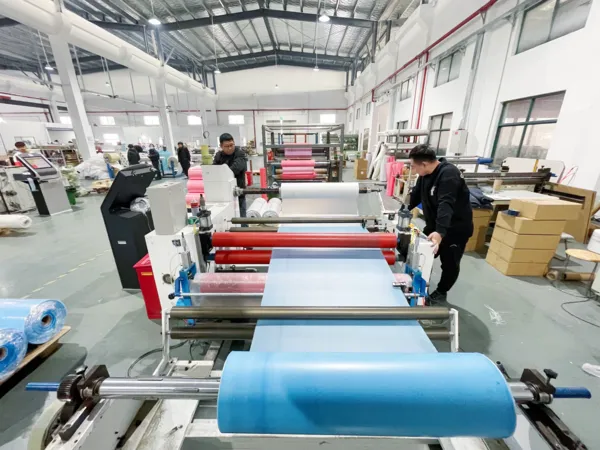
But have you ever wondered how hot melt adhesive films are manufactured?
Converting raw polymer resins into precision adhesive films requires deep expertise in melt rheology, film-forming capability, and thermal stability. Today, Vomelt | HRS breaks down the 4 primary manufacturing methods used in the hot melt film industry.
Coating Method — The Standard for Backed Adhesive Films
Many hot melt adhesive films feature a protective backing paper or PE liner on one side—commonly known as a release liner. The coating method is the primary process used to manufacture these supported (backed) hot melt adhesive films.
Coating Method How It Works
In a coating machine, raw adhesive resin is melted and applied directly onto a moving substrate or release liner. Depending on the chemical properties of the resin, different coating technologies are utilized:
- Roll Coating (Smooth Roll / Gravure)
- Slot Die / Knife Coating
- Spray Coating
- Curtain Coating
Coating Method Key Characteristics
- Primary Output: Supported hot melt adhesive films (with release paper/film).
- Cost Factor: While unsupported films can be made by stripping off the backing paper later, this creates unnecessary material waste and cost.
- Quality Control: Coating production requires strict monitoring of thickness uniformity, surface flatness, and adhesive surface cleanliness.
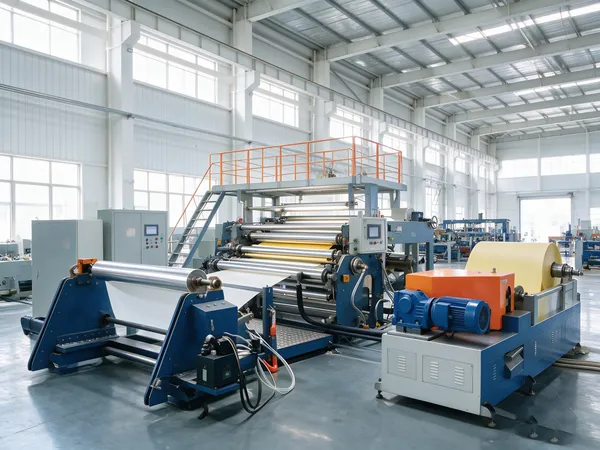
Cast Extrusion Method — The Preferred Choice for Unsupported Films
The cast film extrusion process was originally developed to eliminate the cost of backing paper, giving rise to unsupported (carrier-free) hot melt adhesive films. However, cast extrusion lines can also produce backed films simply by laminating the hot extruded melt onto a release carrier at the cooling roller.
Cast Extrusion method How It Works
Adhesive resin pellets are melted inside an extruder and forced through a flat T-die with a narrow slot. The molten adhesive sheet is pulled by a casting roller and instantly cooled on a water-chilled roller before being wound into rolls.
Why Cast Extrusion Rules the Market:
- Superior Precision: Equipped with flat T-dies and automatic die gap adjusters, cast extrusion maintains ultra-tight thickness tolerances within ±3%.
- High Efficiency & Material Savings: Production speeds are high, and edge trims or waste materials can be recycled inline automatically.
- Exceptional Optical Clarity: Ordered polymer alignment and rapid quenching result in higher film transparency, better flexibility, and superior low-temperature impact resistance.
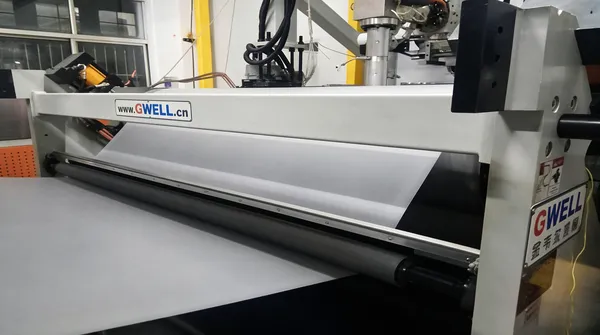
Vomelt | HRS Insight: While cast extrusion requires higher equipment investment than coating lines, it is the absolute gold standard for producing high-transparency, ultra-uniform TPU and PES hot melt adhesive films.
Blown Film Method — An Alternative for Unbacked Films
Originally used for commodity packaging plastics (like LDPE bags), the blown film method is another approach for producing unsupported hot melt adhesive films.
Blown Film Method how It Works:
Molten adhesive resin is extruded vertically upward through a circular annular die. Air is injected to inflate the molten tube into a “bubble,” which is drawn upward, collapsed by a frame, and wound into rolls.
Limitations of Blown Film for Industrial Bonding:
While blown film machinery is widely accessible, it presents notable drawbacks for critical B2B bonding applications:
- High Thermal Shrinkage: The bi-axial stretching during inflation causes severe heat contraction. When customers heat-press the film during lamination, the film shrinks rapidly, leading to delamination or weak bonding.
- Poorer Thickness Uniformity: Stacked circular die cores make micro-adjustments difficult, resulting in thickness tolerances around ±10%.
- Lower Transparency & Stiffness: Compared to cast films, blown films generally exhibit lower optical clarity and inconsistent surface tension.
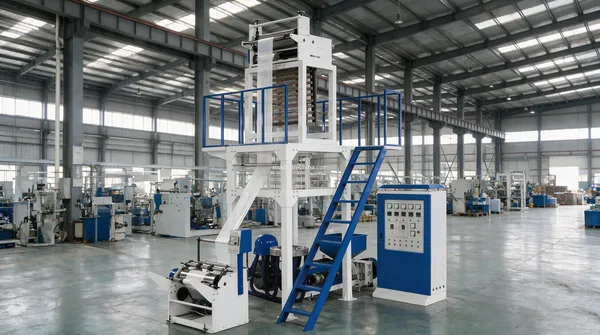
Calendering Method — Dedicated Process for Heavy-Duty / Thick Films
When an industrial application demands a thick hot melt adhesive film (ranging from 1.0 mm to 2.0 mm), the calendering process is the dedicated manufacturing choice.
Calendering Method How It Works
Adhesive resin is melted, extruded through a wide slot die, and immediately fed into a heavy-duty three-roll or four-roll calender stack for pressing, gauging, cooling, and rolling.
Calendering Method Advantages & Limitations
- Key Strengths: Handles heavy film gauges with high thickness consistency and low thermal shrinkage.
- High Barrier to Entry: Calendering lines require massive capital investment—often more than 10 times higher than blown film equipment.
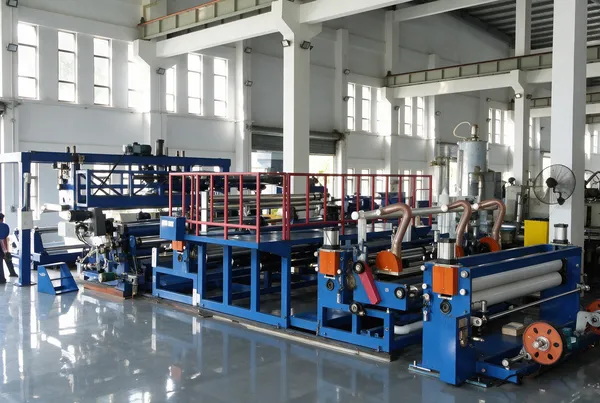
Summary: Comparing the 4 Manufacturing Processes
| Feature / Metric | Coating Method | Cast Extrusion (Recommended) | Blown Film Method | Calendering Method |
| Film Format | Supported (Backed) | Unsupported & Supported | Unsupported | Unsupported (Thick Gauge) |
| Thickness Tolerance | Good | Ultra-precise (≤ ±3%) | Poor (±10%) | Good |
| Product Thickness | Standard Gauges | Standard (≤ 1.5 mm) | Standard Gauges | Thick Gauges (1.0–2.0 mm) |
| Thermal Shrinkage | Low | Low / Stable | High (Risk of Bonding Defect) | Low |
| Production Efficiency | Moderate | High | Moderate | Moderate |
| Equipment Investment | Low | Moderate–High | Moderate | Very High (10x+) |
How to Choose the Right Hot Melt Film for Your Application
There is no single “best” manufacturing method—only the right film for your specific processing line.
- Choose Coated Films if your assembly process requires a protective release paper for pre-positioning or die-cutting.
- Choose Cast Extrusion Films if you require carrier-free films with maximum bonding strength, high transparency, and tight thickness tolerances.
- Choose Calendered Films if your structural bonding requires heavy-duty glue layers exceeding 1.0 mm.
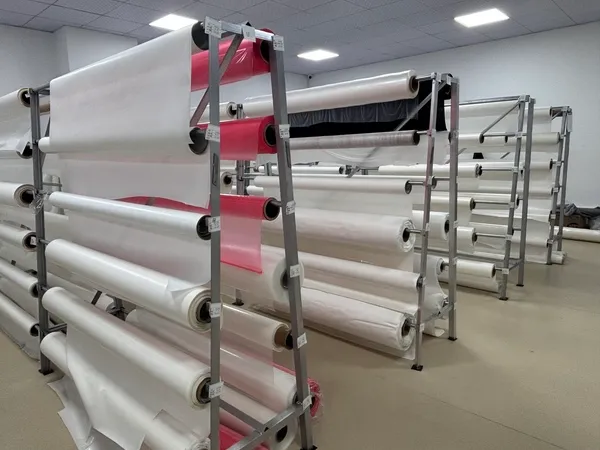
At Vomelt | HRS, we specialize in engineering high-performance hot melt adhesive films (TPU, PES, PA, EVA, PO) tailored to your exact substrate, temperature, and lamination equipment requirements.
Need Expert Guidance on Material Selection?
Contact the Vomelt | HRS technical team today to discuss your bonding challenges or request free sample rolls for trial testing.
- Vomelt | HRS — Simplifying Bonding, Empowering Your Selection.