
Which PES Hot Melt Adhesive Web Is Best for Speaker Grille Cloth Bonding?
Speaker grille cloth needs a secure bond without sealing an open acoustic structure. A continuous adhesive film can create too much coverage, while a web that is too light may not hold pile fabric well. We tested PES adhesive web on real speaker-panel constructions to find a better balance.
For speaker grille cloth bonding to a metal honeycomb panel, PES hot melt adhesive web is a practical starting point because its open structure avoids the continuous barrier created by solid film. In our tests, 15 g/m² provided sufficient bonding for nonwoven dust cloth, while 15 g/m² was insufficient for pile fabric and 25 g/m² gave a much more secure bond. Final weight, temperature, pressure and dwell time still require testing with the actual materials.
The key is not only choosing PES. We also need to match adhesive weight and processing conditions to the actual speaker fabric and panel.
Why Use PES Hot Melt Adhesive Web for Speaker Grille Cloth Bonding?
When we evaluate an adhesive for a speaker component, bond strength is only one part of the problem.
The adhesive also needs to suit the panel material, fabric construction and acoustic structure.
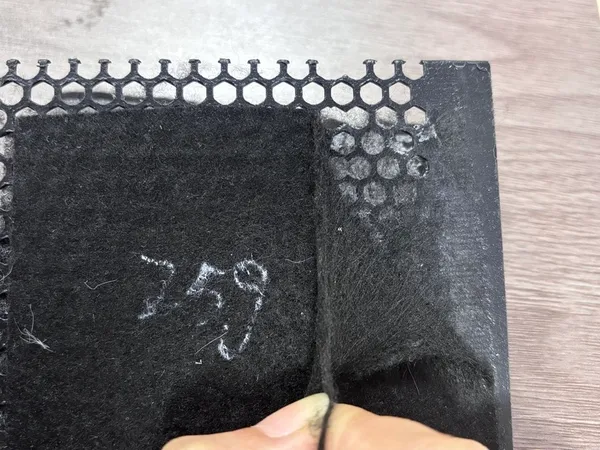
In this application, we were bonding speaker dust-cover materials to a metal honeycomb panel. We evaluated PES hot melt adhesive web because it provided better compatibility with the tested metal panel than the TPU adhesive option we evaluated, while still retaining an open adhesive structure.
That open structure matters. A buyer looking for a speaker grille cloth adhesive does not necessarily need the adhesive with the greatest total surface coverage. If the grille or dust-cover material is designed to remain acoustically open, a continuously sealed adhesive layer may work against that structure.
Does Solid Hot Melt Adhesive Film Affect Speaker Sound Transmission?
A solid hot melt adhesive film forms a continuous layer after lamination. For many bonding applications, continuous coverage is useful. In an acoustic construction, however, that continuous layer can cover open areas between the speaker panel and the fabric.
PES hot melt adhesive web works differently. Its fibrous structure contains open spaces between the adhesive strands. It can bond the two substrates without creating the same fully continuous adhesive barrier across the complete surface.
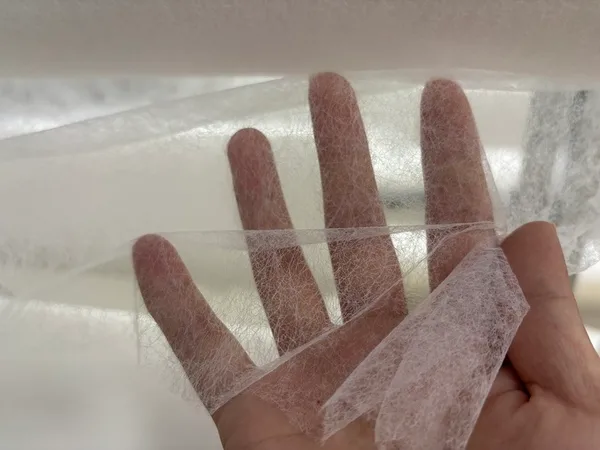
This is one reason we prefer to evaluate adhesive web rather than continuous film for this type of speaker grille cloth and dust-cover construction.
Final acoustic performance should still be verified on the finished speaker assembly. We do not use the open structure alone as proof of a specific acoustic or frequency-response result.
What Did We Test on the Speaker Honeycomb Panel?
We compared different fabric constructions and PES adhesive web weights on the same type of speaker application.
| Material Combination | PES Web Weight | Manual Evaluation |
|---|---|---|
| Metal honeycomb panel + nonwoven dust cloth | 15 g/m² | Sufficient bond; nonwoven remained firmly attached |
| Metal honeycomb panel + pile / velvet-like fabric | 15 g/m² | Bonding was not secure enough for this fabric structure |
| Metal honeycomb panel + pile / velvet-like fabric | 25 g/m² | Much stronger result; fabric remained firmly attached during manual pulling |
These results are application-test observations rather than standardized peel-strength values. The evaluation was performed by manual pulling, so we do not assign an N/25 mm peel value to these samples.
Is 15 g/m² PES Adhesive Web Enough for Nonwoven Speaker Dust Cloth?
In our nonwoven test, 15 g/m² was sufficient for the material combination we evaluated.
The PES web was laminated between the nonwoven dust cloth and the speaker honeycomb panel.
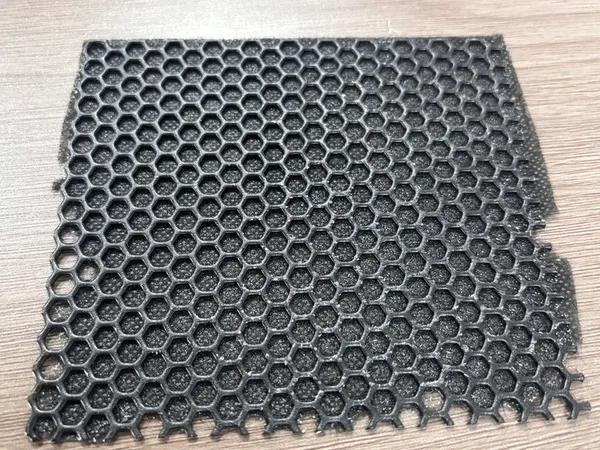
We then manually pulled the bonded material to check whether the nonwoven would separate easily from the panel.
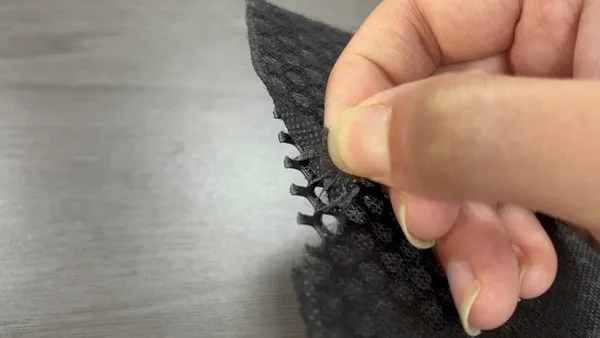
For this particular nonwoven construction, 15 g/m² is therefore a reasonable starting specification.
That does not mean every nonwoven speaker fabric should automatically use 15 g/m². Fiber density, surface treatment, panel structure, temperature, pressure and dwell time can all change the bonding result.
Why Was 15 g/m² Not Enough for the Pile Fabric?
We also tested the same 15 g/m² PES web with a thicker pile or velvet-like speaker grille cloth.
The result was different.
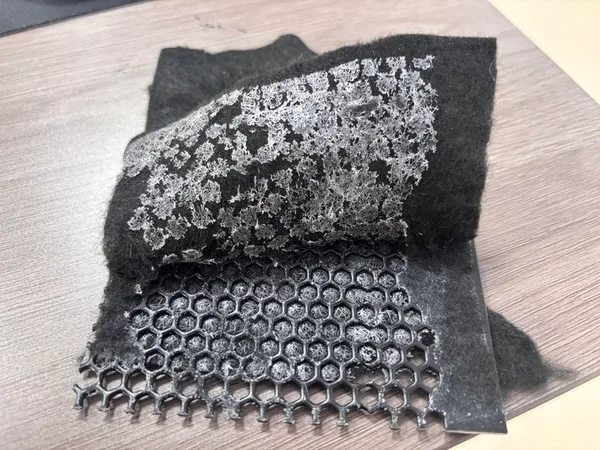
In production, this is sometimes described simply as the fabric “absorbing the glue.” A more useful technical explanation is that pile fabric has a thicker, more porous and three-dimensional fiber structure.
During heating and pressing, molten adhesive can penetrate and distribute into that fiber structure. As a result, less adhesive may remain concentrated at the actual bonding interface between the fabric and the panel.
The same adhesive chemistry can therefore require a different web weight when the fabric construction changes.
Why Did 25 g/m² Work Better on the Pile Fabric?
We increased the PES hot melt adhesive web weight to 25 g/m² and repeated the evaluation with the pile fabric.
The difference was clear during manual pulling. The fabric remained much more securely bonded to the speaker honeycomb panel.
This is an important purchasing point. A lower gsm can reduce adhesive consumption, but choosing the lowest adhesive weight without considering the fabric structure can lead to insufficient bonding.
The better question is not simply, “Which gsm is cheapest?”
The better question is, “Which gsm leaves enough effective adhesive at the bonding interface after lamination?”
What About 20 g/m² PES Hot Melt Adhesive Web?
PES adhesive web can be supplied in different weights. A 20 g/m² construction is another available option between the 15 g/m² and 25 g/m² examples discussed above.
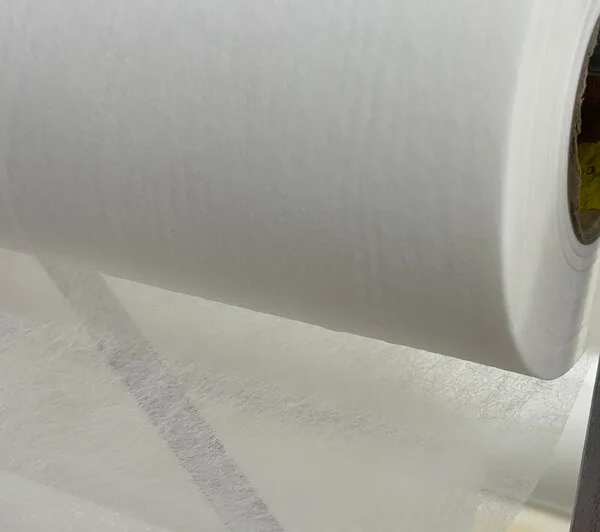
We are not presenting 20 g/m² as the confirmed specification for the pile-fabric speaker application shown here. Our confirmed comparison in this test was 15 g/m² versus 25 g/m².
If a buyer wants to reduce adhesive weight while maintaining sufficient bonding, an intermediate weight can be evaluated with the actual speaker panel and fabric before bulk production.
What Does 15 g/m² PES Adhesive Web Look Like?
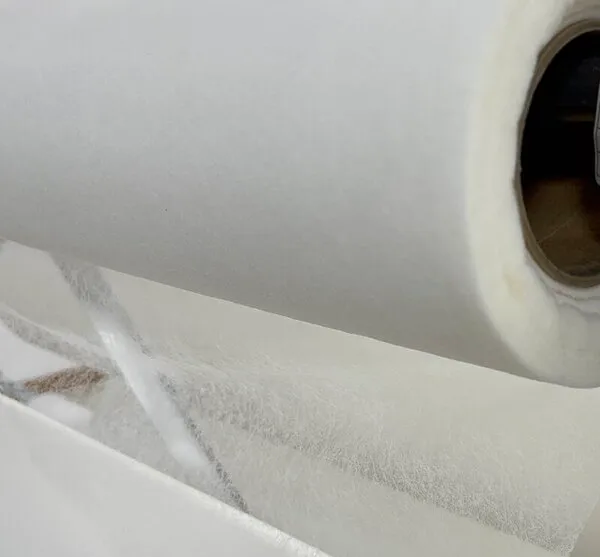
The web structure is important because adhesive weight and adhesive form are two separate selection factors. Two products may both use PES chemistry while having different web weights and therefore behaving differently during lamination.
Why Choose PES Instead of TPU for This Speaker Application?
We also need to select the right adhesive chemistry for the substrate combination.
In the construction we evaluated, the TPU adhesive option tested did not provide the required compatibility with the metal speaker panel, while the PES adhesive performed better.
For that reason, we selected PES hot melt adhesive web as the more suitable starting material for further evaluation.
We do not treat this as a universal statement that TPU cannot bond metal. Adhesion depends on the exact TPU grade, metal surface, coating and processing conditions.
For this tested speaker construction, PES was the better choice.
If you are comparing adhesive chemistries for another substrate combination, send us the actual materials rather than selecting only by polymer name.
What Is the Best Adhesive for Speaker Grille Cloth?
There is no single adhesive weight that is best for every speaker grille cloth.
For a metal honeycomb panel combined with acoustic fabric, we would start by evaluating PES hot melt adhesive web when both metal compatibility and an open adhesive structure are important.
For a relatively flat nonwoven construction, 15 g/m² may be enough. For a thicker, more porous pile or decorative speaker grille cloth, a higher adhesive weight such as 25 g/m² may provide a more reliable bonding interface.
The material should still be tested rather than selected from the fabric name alone.
How Should You Choose Between 15 g/m² and 25 g/m²?
As a practical starting rule, flatter and less adhesive-absorbent nonwoven structures may require a lower PES web weight, while thicker, more porous or pile fabrics often require more adhesive to maintain enough material at the actual bonding interface.
This is a starting rule, not a fixed specification.
Two fabrics both sold as “speaker grille cloth” may behave very differently during lamination because of differences in fiber density, pile structure, surface treatment and porosity.
Why Test the Actual Speaker Materials Before Bulk Ordering?
Choosing an adhesive from a technical data sheet alone can be risky when the finished construction contains different fabrics, coatings or panel surfaces.
Our own comparison demonstrates this clearly:
- 15 g/m² + nonwoven: sufficient bonding in our test.
- 15 g/m² + pile fabric: bonding was not secure enough.
- 25 g/m² + pile fabric: much stronger manual pull result.
The polymer remained PES, but the suitable adhesive weight changed because the fabric structure changed.
Testing the real materials helps avoid selecting a gsm that looks economical on paper but does not provide enough adhesive at the interface during production.
What Should a Buyer Provide Before Ordering?
If you are planning a production order, the following information helps us narrow the starting specification much faster:
| Information | Why We Need It |
|---|---|
| Speaker panel material | Helps evaluate adhesive compatibility |
| Fabric type | Nonwoven, pile fabric, grille cloth or other textile structures can require different gsm |
| Current adhesive and gsm | Provides a useful comparison point |
| Available processing temperature | Helps narrow the suitable PES grade and processing window |
| Pressure and dwell time | Both influence adhesive flow and penetration |
| Required roll width | Needed for production planning |
| Estimated monthly usage | Helps us discuss production supply, MOQ and lead time |
Does Speaker Grille Cloth Affect Sound?
The fabric construction itself can influence acoustic transmission, and the bonding layer can also affect the final structure.
For that reason, we do not want the adhesive to turn an intentionally open speaker grille into a continuously sealed layer.
PES adhesive web allows adhesive to be distributed across the bonding area while retaining open spaces between adhesive fibers.
Final acoustic performance should still be checked on the complete speaker assembly rather than assumed from the adhesive structure alone.
Can We Test Your Speaker Grille Cloth and Panel?
Yes. If you are purchasing PES hot melt adhesive web in production quantities, you can send us the actual speaker panel and grille cloth for application evaluation.
We do not select PES adhesive web by polymer name alone. We look at the actual substrate combination, fabric structure, adhesive weight and available processing conditions before recommending a starting specification.
If you are planning a production order, send us your speaker panel material, fabric type, required roll width, current adhesive, available processing temperature and estimated monthly usage.
We can then discuss sample testing, suitable starting gsm, production specifications, MOQ and lead time.
Send Your Speaker Materials for Bonding Test
Frequently Asked Questions
What adhesive is suitable for speaker grille cloth?
Why use hot melt adhesive web instead of solid adhesive film?
Is 15 g/m² enough for speaker dust cloth bonding?
Why does pile fabric need more adhesive?
Can PES hot melt adhesive web bond to a metal speaker panel?
Is 25 g/m² always better than 15 g/m²?
Summary
For speaker grille cloth bonding, polymer type, web structure and adhesive weight all matter. Our tests used 15 g/m² PES web successfully with nonwoven dust cloth and 25 g/m² for pile fabric on a metal honeycomb panel. Send us your actual materials before bulk ordering.